How Many Points to Fly Business Class to Europe? Honest Math

Updated: 4 days ago
You have points sitting in an Amex or Chase account and a vague sense that they could get you somewhere good. So the practical question is how many points to fly business class to Europe, and the honest answer is that it depends far more than most guides admit.
The number you will see everywhere is 60,000 points one way. That number is real. It is also a floor, not an average.
The same route can cost 60,000 points on a Tuesday in February and 138,000 points on a Friday in July, because most programs now price awards dynamically, meaning the points cost moves with demand the same way cash fares do.
This post gives you the real range across eight programs, tells you which three are actually worth your time, and shows you the surcharge math that most guides leave out.
The Short Version
Business class to Europe from the East Coast typically runs 45,000 to 75,000 points one way, with 60,000 as the realistic number to plan around. Iberia Avios drops to 34,000 off-peak if you are flying to Madrid, and Virgin Atlantic starts near 29,000 to London, though Virgin adds roughly $1,000 or more in surcharges per round trip. Air France Flying Blue Promo Rewards, released the first of every month, is the most reliable way to book below 60,000.
How Many Points to Fly Business Class to Europe: The Real Range
Here is what each program charges for a one way business class seat from the East Coast, as of July 2026. Read the surcharge column as carefully as the points column, because that is where the actual cost hides.
Program | Points (one way) | Surcharges | Transfers From | Best For |
Air France Flying Blue | 45,000 to 75,000 | Around $260 each way | Amex, Chase, Capital One, Citi | Best all-round pick, monthly discounts |
Iberia Avios | 34,000 off-peak, 50,000+ peak | Low | Amex, Chase, Capital One | Cheapest option, Madrid only |
Air Canada Aeroplan | 60,000 to 160,000 | Low on most partners | Amex, Chase, Capital One | Widest route coverage |
Virgin Atlantic | 29,000 and up | $586 out, around $650 back | Amex, Chase, Capital One, Citi | Lowest points price, highest cash cost |
Avianca LifeMiles | 63,000 and up | Very low | Amex, Chase, Capital One, Citi | Star Alliance without fuel surcharges |
TAP Miles&Go | 63,000 and up | Moderate | Capital One only | Lisbon and Porto |
American AAdvantage | 57,500 and up | Low | No bank transfers | Only if you already have the miles |
United MileagePlus | 80,000 and up | Low | Chase | Rarely the best price for the same seat |
The spread in that table is the whole story. The same lie-flat seat can cost you 34,000 points or 160,000 points depending on which program you book it through, and that is before you count the cash.
If you take one thing from this table, take this: the program you book through matters more than the airline you fly.
The Three Programs Worth Your Time
Eight programs is a lot to think about when you just want to get to Europe.
If you are only asking how many points to fly business class to Europe so you can book one trip and move on, these are the three that matter. Here is how I would rank them for someone with Amex or Chase points and no interest in becoming a hobbyist.
Start here: Air France Flying Blue
Flying Blue is the program I recommend most often, and it is the one I have personally booked. Availability is genuinely good, especially if you set alerts early.
Award space opens up to eleven months out, and turning on alerts that far ahead will almost always find you something near your target dates.
The mechanic that makes Flying Blue worth learning is Promo Rewards. Every month, Flying Blue discounts a rotating set of routes by 25 to 50 percent.
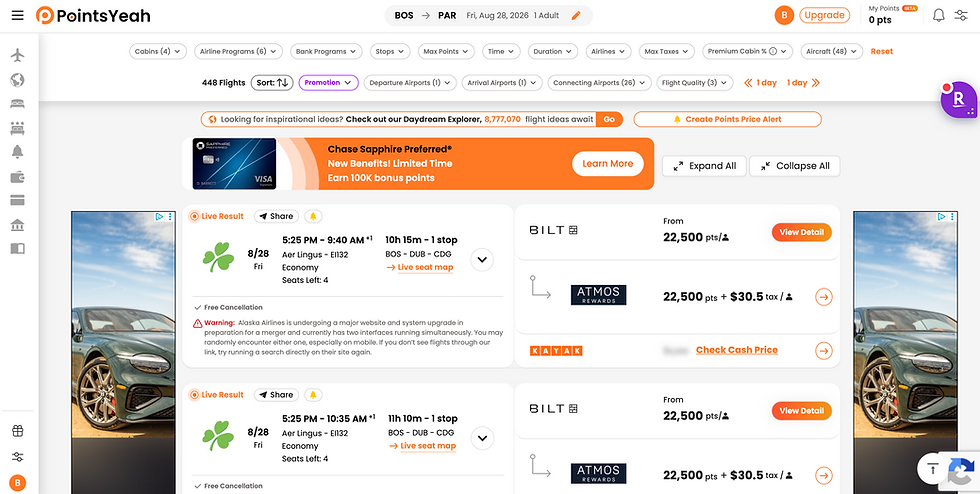
Checking the first of the month is the single highest value habit in this entire post. Recent Promo Rewards have put business class from New York to Europe at 45,000 miles.
Stack a Promo Reward with a transfer bonus, which is when a credit card program temporarily gives you extra airline miles for the same points, and the effective cost drops closer to 48,000 points. That is the sweet spot, and it happens several times a year.
Flying Blue is not free of downsides. Surcharges run around $260 each way, so budget roughly $500 round trip. KLM, which is part of the same program, sometimes has availability when Air France does not, so always check both.
Flying Blue is the default answer for most people, and the first of the month is when you should be looking.
Start here: Iberia Avios, if you are going to Spain
Iberia is the cheapest business class to Europe available to anyone with Amex or Chase points, and it is badly underused.
Off-peak business class from New York, Boston, or Washington to Madrid starts at 34,000 Avios one way. With a transfer bonus, that can drop closer to 29,000.
The catch is real. Peak dates push it to 50,000 or more, and Iberia flies far fewer routes than Flying Blue or Aeroplan.
If Madrid is your destination or a workable connection point, this is the best value in the market. If you are heading to Paris, Amsterdam, or Zurich, look elsewhere.
For Spain, nothing beats Iberia off-peak. For everywhere else, it is not a serious option.
Start here, with a warning: Virgin Atlantic to London
Virgin has the lowest headline number on the list.
Upper Class, which is Virgin's name for business class, has recently been available from the East Coast to London starting around 29,000 points, sometimes 23,000 with a transfer bonus, with good availability across multiple US cities.
Then the surcharges arrive. Virgin raised award fees twice in the past year.
Business class awards from the US to London now carry a flat fee of roughly $586 each way, with returns from the UK running closer to $650. Live pricing for a Boston to London round trip in Upper Class currently shows around 115,000 points plus $1,875.
I do not tell clients to avoid Virgin. I tell them the real number.
If the dates and the route are exactly what you want and you are comfortable paying that cash component, it can still be a solid deal against a $4,000 fare. Just do not book it thinking you got a nearly free flight.
There is one workaround worth knowing. Virgin charges those fuel surcharges on its own flights, not on partner awards. Virgin points booked on Delta One to Europe sidestep the problem entirely.
Virgin has the best points price and the worst cash price on this list, and you need to look at both before you book.
Worth Knowing: Aeroplan, LifeMiles, and TAP
Air Canada Aeroplan has the widest route coverage of any program here, because it opens up Lufthansa, SWISS, Austrian, and United Polaris in addition to Air Canada's own flights.
Pricing starts at 60,000, but dynamic pricing means it can climb past 160,000 on busy dates. Chase cardholders with the Aeroplan card get a standing 10 percent transfer bonus, which can put a business class seat at around 55,000 Chase points.
Avianca LifeMiles is the quiet pick for anyone who hates surcharges. It books the same Star Alliance flights as Aeroplan, starts around 63,000, and charges very little in fees. The website is genuinely frustrating to use, which is the trade-off.
TAP Miles&Go is useful only if you are going to Portugal, and only if you have Capital One points, since Capital One is the sole US bank that transfers there. Worth knowing about, rarely worth planning around.
These three are the second tier: real options, but not where you should start looking.
Two Things That Will Cost You If Nobody Tells You
This is the section I wish someone had given me before my first booking.
Award seats disappear when you try to book a connection
Here is a trap that catches people constantly. You search a route with a connection and see plenty of availability on each individual flight, six seats, nine seats, all wide open. Then you try to book them together and the availability collapses to two.
This happened to us last summer. Each leg showed nine or more seats, but the full itinerary with the connection would only book two.
I called the airline to confirm. They explained that only two seats were available for the complete routing, regardless of what each individual flight showed.
We booked the flights separately and it worked out. If you end up doing that, two rules.
Leave a buffer of at least three hours between flights, because separate tickets are not linked and the airline has no obligation to protect you if the first one is late. And have a backup plan for the second leg before you commit.
Point transfers are not always instant
Most transfers from Amex or Chase to an airline land in minutes. Sometimes they take a few days. That gap is stressful, because award availability can vanish while you are waiting and transfers cannot be reversed.
The rule that follows from this is simple and it is the most important one in this post. Find the seat first. Confirm it is bookable. Then transfer. Never move points into an airline program hoping a seat will appear.
Transfers are permanent and one way, so the seat comes first, always.
Why Flexible Points Beat a Big Balance
A client came to me recently with more than 500,000 American Airlines miles. That sounds like a fortune.
In practice he is more restricted than someone with 80,000 Amex points, because AAdvantage miles cannot be transferred out to another program. He is locked into whatever American and its partners have available.
That is the case for transferable points, which are credit card points you can move into different airline programs at a set ratio, usually one to one. Amex Membership Rewards, Chase Ultimate Rewards, and Capital One miles all work this way.
If Flying Blue has nothing on your dates but Iberia does, you send your points to Iberia. A big balance in a single airline program cannot do that.
There is a related judgment call worth making honestly. Points work best when you have flexibility.
If you need a specific flight on a specific date on a route that rarely goes on sale, cash is often the better call. Points are a flexibility tool, not a universal discount.
Eighty thousand flexible points will beat half a million locked-up miles more often than you would think.
How to Find Out If a Seat Actually Exists
Knowing the points price is step one. Step two is finding out whether a business class seat exists on your route and your dates before you commit anything.
Checking eight programs by hand means eight separate websites, most of which are slow and several of which require an account before they will show you anything.
An award search tool checks them all at once. Roame searches more than 25 loyalty programs simultaneously and shows you which flights have award seats, what they cost in points, and which credit card programs transfer there. Use code BRTRAVEL for the best available discount on your first payment.
The free version handles a basic search. The paid plan adds alerts when a seat opens on your route, which matters more than it sounds, because the Flying Blue strategy above depends on catching Promo Rewards and new availability early.
The honest limitation: no search tool is perfect. Availability can shift between when you search and when you book, and some programs do not surface every seat to third party tools. Confirm on the airline's own site before you transfer.
Not sure which tool to use? check out my two favorite tools: how Roame compares to Seats.aero.
If you want the full decision process for matching your specific points balance to a destination, the AI Points Maximizer walks through it step by step, including a real booking from Boston to Zurich.
Book the Flight Yourself. Let Someone Else Handle the Hotel.
Here is where I will say something most points blogs will not.
The flight is the part you can do yourself. It takes an evening, the tools above do most of the work, and the money you save is real. The hotel is where doing it yourself quietly costs you.
Hotel points are mostly mediocre value in Europe. World of Hyatt is the exception, and it is genuinely good.
Park Hyatt Paris-Vendôme runs 35,000 to 75,000 points against cash rates that average more than $900 a night in peak season, which is over two cents per point. Park Hyatt Vienna sits around 30,000 points. Barcelona and Madrid are comparable.
Two catches. Hyatt overhauled its award chart in May 2026 and peak pricing at top properties went up meaningfully, so it is not the deal it was two years ago.
The bigger one: Hyatt only takes transfers from Chase and Bilt. If your points are in Amex or Capital One, you cannot get there at all.
Your Amex options are Marriott and Hilton, and the math is poor. One Paris property runs 70,000 Hilton points against a $300 cash rate. That is half a cent per point.
So for most of Europe, book hotels with cash. That is not a concession, it is the better play, because booking through a travel advisor with Virtuoso and Hyatt Privé access gets you upgrades, breakfast, resort credits, and early check-in at the same rate you would pay booking direct.
The properties I steer clients toward are the small ones.
Cap Rocat in Mallorca is a restored military fortress cut into the cliffs, 30 suites, fifteen minutes from Palma airport, with a private cove below the walls.
Cap Estel sits on its own private cape between Nice and Monaco with about 20 rooms and a private beach, and it is the quiet answer to the crowded stretch of Cap-Ferrat.
Casa Fantini Lake Time is in the village of Pella on Lake Orta, the lake nobody thinks of before Como, 45 minutes from Milan Malpensa.
Casa do Rio in the Douro has eight suites, an infinity pool over the valley, and is remote enough to need a two night minimum. None of those will show up in a portal search, which is exactly the point.
Use your points on the flight, use an advisor on the hotel, and you get the best version of both.
If you have found your flight and want the hotel handled properly, get in touch. That is the part I do.
Frequently Asked Questions
How many points do I need to fly business class to Europe?
Business class to Europe from the East Coast typically runs 45,000 to 75,000 points one way, with 60,000 as a realistic planning number.
Iberia Avios starts at 34,000 off-peak to Madrid, and Virgin Atlantic can start near 29,000 to London, though Virgin adds roughly $1,000 or more in surcharges per round trip. Air France Flying Blue Promo Rewards, released the first of each month, regularly puts business class at 45,000 to 55,000.
Can I use Amex points for business class to Europe?
Yes. Amex Membership Rewards transfers at one to one into Air France Flying Blue, Iberia Avios, Air Canada Aeroplan, Virgin Atlantic, and Avianca LifeMiles, all of which have business class award space to Europe.
Amex does not transfer to World of Hyatt, so Amex points are better used on flights than European hotels.
Can I use Chase points for business class to Europe?
Yes. Chase Ultimate Rewards transfers at one to one into Flying Blue, Iberia, Aeroplan, Virgin Atlantic, and United. Chase also transfers to World of Hyatt, which makes it the most useful currency of the three for combining a flight and a hotel on points.
Why does the same flight cost different amounts of points on different days?
Most programs now use dynamic pricing, which means the points cost moves with demand the way cash fares do. Aeroplan can start at 60,000 and climb past 160,000 on the same route.
This is why the advertised 60,000 figure is a floor rather than an average, and why flexible dates save far more points than any other single tactic.
Should I transfer my points before I find a seat?
No. Always confirm the seat is available and bookable first, then transfer. Transfers are one way and cannot be reversed, and transfers do not always land instantly. Sometimes they take a few days, during which the seat can disappear.
The Bottom Line
If you came here asking how many points to fly business class to Europe, the 60,000 point figure you see everywhere is a starting price, not a typical one. Plan around 60,000, expect to see more on peak dates, and treat anything under 50,000 as a genuine win.
If you only remember three things: check Flying Blue Promo Rewards on the first of every month, book Iberia if you are going to Spain, and look at the surcharge column before you get excited about a low points price.
Then book the flight yourself and hand the hotel to someone who can get you upgraded. Start with a Roame search to see what is actually available on your dates, and use code BRTRAVEL for the best available discount if you decide to set up alerts.
This post contains affiliate links. If you sign up or purchase through my links, I may earn a small commission at no extra cost to you. I only recommend tools I genuinely use and trust.


Comments